



Production
During production, teams establish more standardized workflows. While prototyping continues for lower-priority items, most of your high priority and critical items will have already completed those stages by this point. Production focuses on generating sufficient content for a complete game, with art teams developing assets, developers implementing gameplay code, and level designers transforming greyboxed levels into final versions.
As digital assets multiply, version control becomes essential. Tools like Perforce and PlasticSCM manage game assets differently than source code. Digital assets are usually modified in their entirety, whereas code can be modified and merged together. Digital asset management tools integrated with source control enable early-stage versioning and team access.
World Building
World building brings level design to life through asset implementation. Multiple disciplines collaborate: programmers test for edge cases and performance targets, playttesters identify design flaws, and creative directors ensure aesthetic alignment.
This coordination-intensive process often faces bottlenecks. Traditional solutions like level sectioning have limitations. KinematicSoup created Scene Fusion to enable a team to work within a single level in real-time, supporting instantaneous feedback across disciplines.
The Importance of Testing
Testing encompasses both code-level and playtest evaluation. Unit testing frameworks like nUnit, CppUnit, and Unreal’s UFE tool help developers write testable code and generate automated reports.
Playtesting occurs in two stages: Quality Assurance tests for internal bugs and functionality, while User Acceptance Testing evaluates player reception. The critical thing to remember with testing is that it needs to occur early and it needs to happen often.
The End of Production
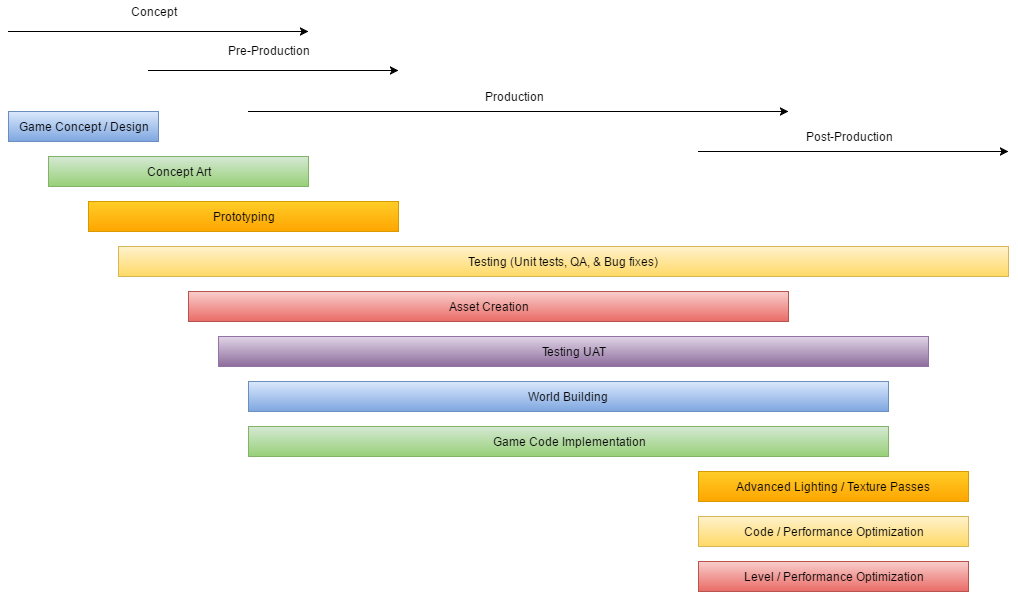
As production concludes, development enters post-production, the final polishing phase addressing remaining bugs through small tweaks to the design or aesthetic of the game such as adding clutter or non-critical props, final lighting passes, performance optimization, and non-critical bug fixes.