



Jayun Noe, known online as m0dE, is the founder of Braains.io Inc. He built braains.io, a web-based multiplayer zombie tag game where up to 50 players fight to survive an outbreak. It took him about 3 months to build, and when he launched it, players loved it.
That was also the problem.
Bandwidth was eating the profits
Like a lot of successful .io game developers, Jayun found that most of what the game earned went straight back out the door in bandwidth costs. His team spent months grinding through optimizations just to get it into the black. By the time the game was profitable, the peak had passed.
Optimization is hard, and easy to get wrong, even on a game that already shipped and did well. A lot of braains.io’s bandwidth came down to an encoding problem: its binary network payloads were base64-encoded into JSON by the libraries it used, then sent without compression. That inflated every update, and the cause was not obvious. Finding it cost the team months.
He had a clear idea for a second game. This time, he wanted to get the economics right from the beginning.
Building braains2 with Reactor and Scene Fusion
Jayun found out about Reactor and Scene Fusion through us. He knew we had built kazap.io ourselves, so he reached out to ask how it was done.
What he was trying to do with braains2 was a real step up from the original: 100 players instead of 50, twice as many physics objects, double the server update rate, and a move from 2D to 3D. That is a lot more data to push every frame. The only way to pull it off at a reasonable cost was to let Reactor handle the compression and real-time optimization.
We partnered with him on the build.
His team used Scene Fusion to collaborate on level design, which kept things moving fast on the 3D environments. Reactor took care of the multiplayer side: state synchronization, physics, bandwidth compression, server infrastructure, all of it.
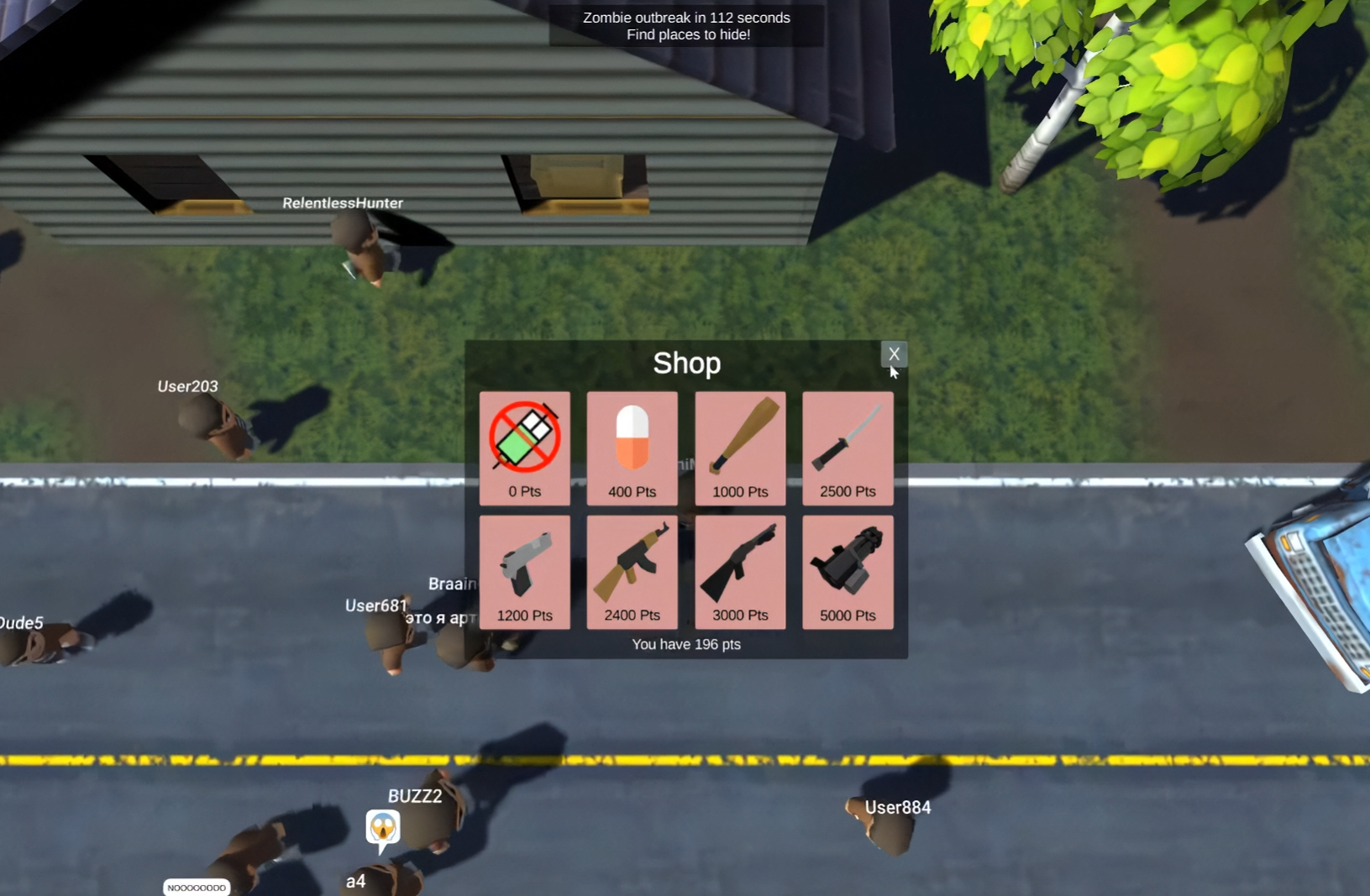
Four weeks later, braains2 had a playable release candidate. The original braains.io took 15 weeks to get there.
The numbers
| braains.io | braains2 (Reactor) | |
|---|---|---|
| Players per room | 50 | 100 |
| Update rate (Hz) | 15 | 30 |
| Inanimate physics objects | 70 | 150 |
| Bits per object per update (uncompressed) | 96 (2D) | 194 (3D) |
| Bandwidth per player at full load | ~300 KB/s | ~35 KB/s |
| Cost per MAU (AWS bandwidth) | $0.024 | $0.0027 |
| Time to release candidate | 15 weeks | 4 weeks |
Braains2 has to move 10x as much data per frame as the original game, between the move to 3D, twice the players, and double the update rate. Even so, total bandwidth came down by a factor of 8, and the cost per monthly active user dropped to about 1/10th of what it was. Nobody hand-tuned the serialization for it. Reactor builds and optimizes the wire format on its own, so the encoding problem that hurt braains.io is off the table.
That made something possible that was not viable before: running servers in South America, close to where most braains players actually are. Lower latency, better experience.
What we learned from this
Braains2 did not go viral the way the original did. That moment had already passed. But what it gave us was a controlled, side-by-side comparison of two versions of the same game, same developer, same concept, same audience, one built without Reactor and one built with it.
At the traffic levels braains2 sees today, Reactor’s bandwidth savings are what keep the game from losing money. At the traffic levels a hit game sees, the same savings become a significant business advantage: lower costs from launch, more players per server, and the freedom to run servers where your players actually are.
Jayun built a better game faster than the first one, and it costs a fraction of what the first one did to operate. That is exactly what Reactor is supposed to do.